Final Reflection Essay
Mame Diarra Ndiaye
English 110
Final Reflection Essay
Throughout this semester in English 110, I grew as a writer in ways I didn’t expect. When the class first started, I thought writing was only about putting sentences together correctly. Now, after completing the literacy narrative, the rhetorical analysis, and the synthesis essay, I understand that writing is actually about choices, choices about audience, genre, purpose, and voice. This course helped me develop skills in thesis writing, research, how to cite sources properly, and understanding how to write for different audiences and genres. Most importantly, I learned these things through the feedback I received from my peers and professor, which pushed me to rethink how I write and why I write and how I show credibility. In this reflection, I will explain my most significant learning and how each assignment helped me grow.
One of the biggest skills I developed this semester was writing stronger and clearer thesis statements. At the beginning of the course, my thesis statements were either too broad or too simple. I often wrote something that repeated the prompt instead of making an original claim and also I kept dragging my idea. This became very clear during my literacy narrative. I remember struggling to figure out what the “point” of my story was. My professor wrote in the margin that my thesis should “I should focus on a specific moment” and “it should guide the whole story.” That comment made me rethink my approach. After revising, I finally wrote a thesis that reflected the deeper meaning of my experience: the idea that “the way we write reflects our identity.” Adding that line gave my essay more focus, and it helped me understand that a thesis isn’t just a requirement, it’s the foundation of the entire piece. This lesson continued to help me in later assignments, especially the synthesis essay where a clear thesis made organizing my research much easier.
Another important skill I gained was understanding the audience and genre. Before this class, I didn’t really think about who I was writing for. I wrote the same way for every assignment, no matter the purpose. But each project this semester required a different approach. In the rhetorical analysis, I learned how to think about what an author does to reach a specific audience as they make sure the context, purpose, tone, audience shape any writing. By exploring and analyzing a variety of rhetoric, I learned different methods authors use to convey a message. And one example,“Should writers use they own English?” said, “Don’t students have a right to their own language if that language makes them vulnerable to prejudice?” This quote made me think deeply about how language changes depending on your audience. It’s not only about English but how you are being yourself and identity. It was insightful to me because of the way it argues that writing is not about sounding professional or smart, but how we are ourselves.
A third major area of growth for me was research and integrating sources, especially during the synthesis essay. Research used to feel intimidating because I didn’t know how to choose good sources or blend them with my own ideas. During the synthesis project, I had to learn not just how to find reliable sources, but how to use them in a meaningful way. I had to shift again, this time writing for an academic audience that expected evidence, research, and credible sources. These experiences showed me that the audience and genre shape every decision a writer makes: tone, structure, examples, even the kinds of sentences I use.The feedback I received from my peers was extremely helpful here. She pointed out that I wasn’t showing enough expertise as I had to include personal experience.After reading his comments, I went back and revised my paragraphs. I added more my own experience about why the source mattered and how it supported my argument. I thought I was good then….
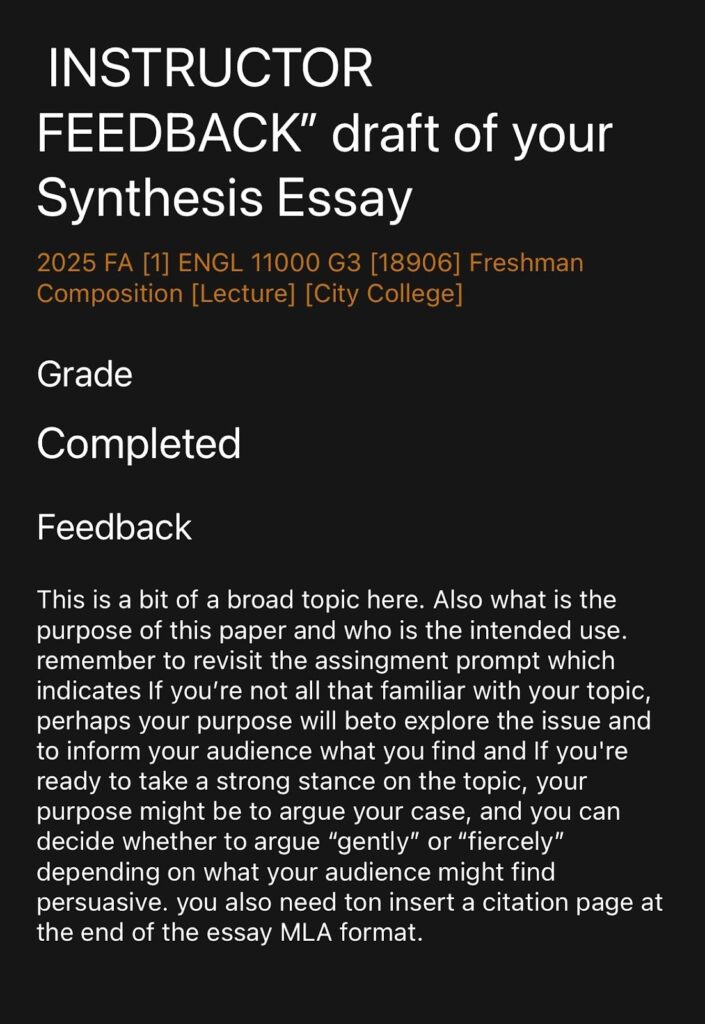
When I saw her feedback I was like no, I couldn’t do it. But thinking about the one that would read this, “My audience”, I just wanted to make it perfect.
Through this process, I realized that research is not about collecting quotes. It’s about creating a conversation between sources and my own voice. This helped me feel more confident and less afraid of academic writing.
Feedback was one of the most important learning moments for me this semester. Peer review especially taught me how useful it is to have someone else read my work. Sometimes my classmates pointed out things I didn’t even notice; like sentences that sounded confusing or paragraphs that needed more detail. Their comments helped me see my writing from a different perspective. My professor’s feedback also pushed me to grow. She didn’t just tell me what was wrong; she explained why changes would make my writing stronger. For example, she often encouraged me to expand my analysis or make my ideas more specific. Over time, I started hearing her voice in my head while I revised, reminding me to slow down and think more deeply. The combination of peer and professor feedback helped me become more confident in rewriting, restructuring, and polishing my essays. I learned that revision is not a punishment,it is a chance to make my writing clearer and more meaningful.
Finally, my understanding of writing itself has changed. At the beginning of the semester, I believed good writing was about sounding formal and avoiding mistakes. Now I know writing is about communication and connection. It’s about finding a purpose, choosing a voice, and shaping ideas based on who will read them. I learned that writing is not fixed, it grows, just like people do. The literacy narrative taught me to look toward the inside. The rhetorical analysis taught me to look toward the outside at how others write. The synthesis essay taught me to enter academic conversations and create my own place in them. Together, these assignments showed me that writing is not just an academic skill, it’s a personal tool I will keep using in my life.
In conclusion, English 110 helped me grow as a writer in ways that feel meaningful and lasting. I improved my thesis writing, became more aware of the audience and genre, and strengthened my research skills. Most importantly, I learned to value feedback and revision as essential parts of the writing process. This class helped me understand that writing is not just about rules, it’s about identity, purpose, and communication. I leave this course feeling more confident in my abilities and more aware of my voice as a writer. These lessons will guide me not only in future college assignments but in any writing I do moving forward.

This entry is licensed under a Creative Commons Attribution-NonCommercial-ShareAlike 4.0 International license.

